Academic events, department notices, student announcements, and
selected achievements are published here.
Curriculum transition guide published for students subject to
the former Artificial Intelligence Engineering curriculum
We have published a transition guide for students enrolled in
Hacettepe University's former Artificial Intelligence
Engineering program. Students who will register for Semester 2
or a later semester in Fall 2026–2027 remain subject to the
curriculum under which they enrolled; their graduation
requirements therefore continue to be determined by that
curriculum.
The guide explains how courses that will no longer be offered
are replaced by their CMP- or AID-coded equivalents, how
technical-elective requirements are handled, which
prerequisites continue to apply, how possible ECTS differences
may be completed, and what students should check before course
registration. Students who register for Semester 1 in Fall
2026–2027 are subject to the new Artificial Intelligence and
Data Engineering curriculum and are not covered by this guide.
The document is provided for information only. Relevant board
decisions and the Hacettepe University Regulation on Associate
and Undergraduate Education and Examinations are binding.
Students should review the guide and their planned
registrations with their academic advisor.
TÜBİTAK 1001 funding awarded for real-time mobile protection
against voice phishing
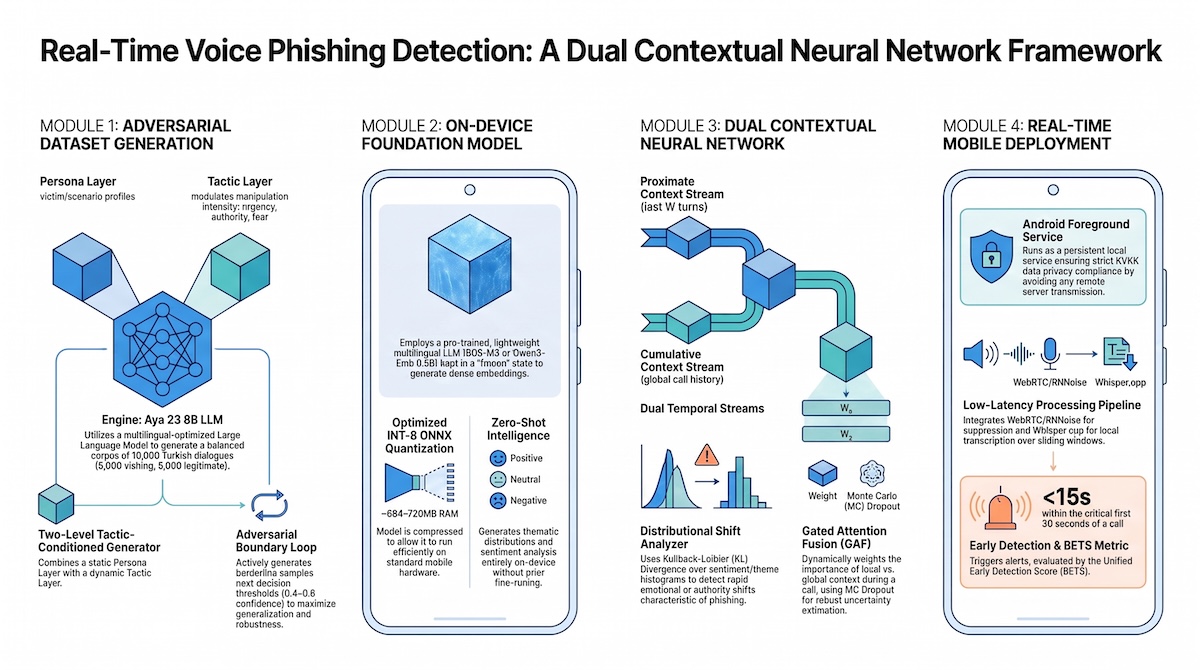
The project will develop an integrated system spanning
dataset generation, real-time detection, and on-device
mobile deployment.
The project proposal
“Development of a Dialog Generator, Dataset, Method and
Mobile Platform for the Real-Time Detection of Voice
Phishing Attacks” , led by Asst. Prof. Dr. Ahmet Selman Bozkır of our
department, has been awarded funding under the TÜBİTAK 1001 –
Scientific and Technological Research Projects Support
Program.
Voice phishing has become an increasingly significant threat
with the spread of AI-assisted voice cloning and sophisticated
social engineering techniques, often targeting elderly
individuals and people with limited technological awareness.
Over the course of 18 months, the project will create an
original and balanced synthetic conversation dataset
reflecting Turkish-language scenarios and diverse speaker
profiles.
The project will also develop a lightweight deep learning
method capable of assessing risk at each turn while a call is
still in progress, rather than analysing the conversation only
after it has ended. The method will take emotional and
thematic cues into account, and a new evaluation metric will
be proposed to measure how early a threat can be detected
reliably.
One of the project outcomes will be a free Android application
that performs all analyses directly on the mobile device. By
avoiding the transmission of conversation data to a remote
server, the application is designed to protect user privacy.
Assoc. Prof. Dr. Murat Aydos will serve as a researcher on the
project, which will also support one MSc scholarship student.
Our students win the Turkcell Code Night Türkiye final
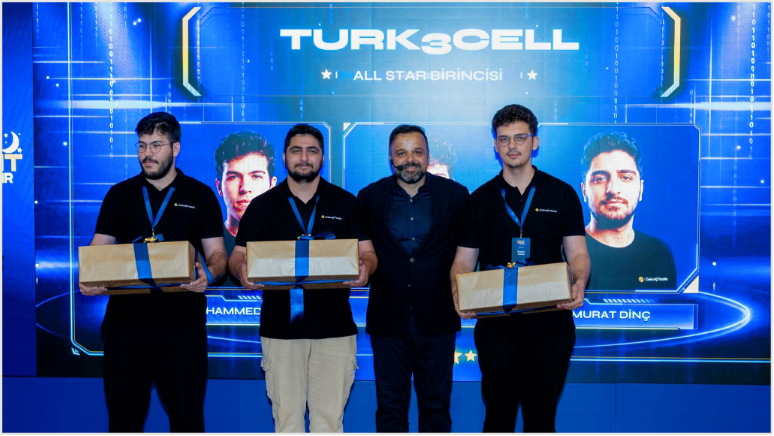
The winning team at the Turkcell Code Night Türkiye final.
Artificial Intelligence Engineering students Muhammed Ekinci
and Murat Dinç, who will continue their studies within the
Department of Artificial Intelligence and Data Engineering,
and Computer Engineering student İbrahim Yılmaz won first
place in the Turkcell Code Night Türkiye final.
The team competed against participants from across Türkiye,
including teams with graduates and master’s and doctoral
students, and received the award from Turkcell CEO Dr. Ali
Taha Koç. We congratulate our students on this achievement.
Our students' capstone project leads to a paper accepted at
the GAIA Workshop at ECCV 2026
Building on capstone projects completed by our students, the
paper “When Does the Second View Help? Auditing Cross-View
Fusion in Urban Vision-Language Models” has been accepted to
the GAIA Workshop, held in conjunction with ECCV 2026 in Malmö
this September.
The study introduces CityViews, a benchmark spanning 12 task
families across 40 cities in 32 countries. Each example pairs
satellite imagery with four road-aligned street-level views,
allowing the same question to be evaluated with
satellite-only, street-view-only, and combined inputs. The
analysis shows that the benefit of adding a second view is
task-dependent: it can be limited when one view already
contains sufficient evidence, but substantial when the answer
depends on correspondence between the two viewpoints.
The paper was co-authored by Computer Engineering student Ezel
Bayraktar; Artificial Intelligence Engineering students
Alperen Demirci, Mukhamediyar Amanzhol and Adam Sattout; Aykut
Erdem (Koç University) and Erkut Erdem.
The Turkish radiology report generation study conducted as
part of our students’ capstone project was presented at SİU
2026
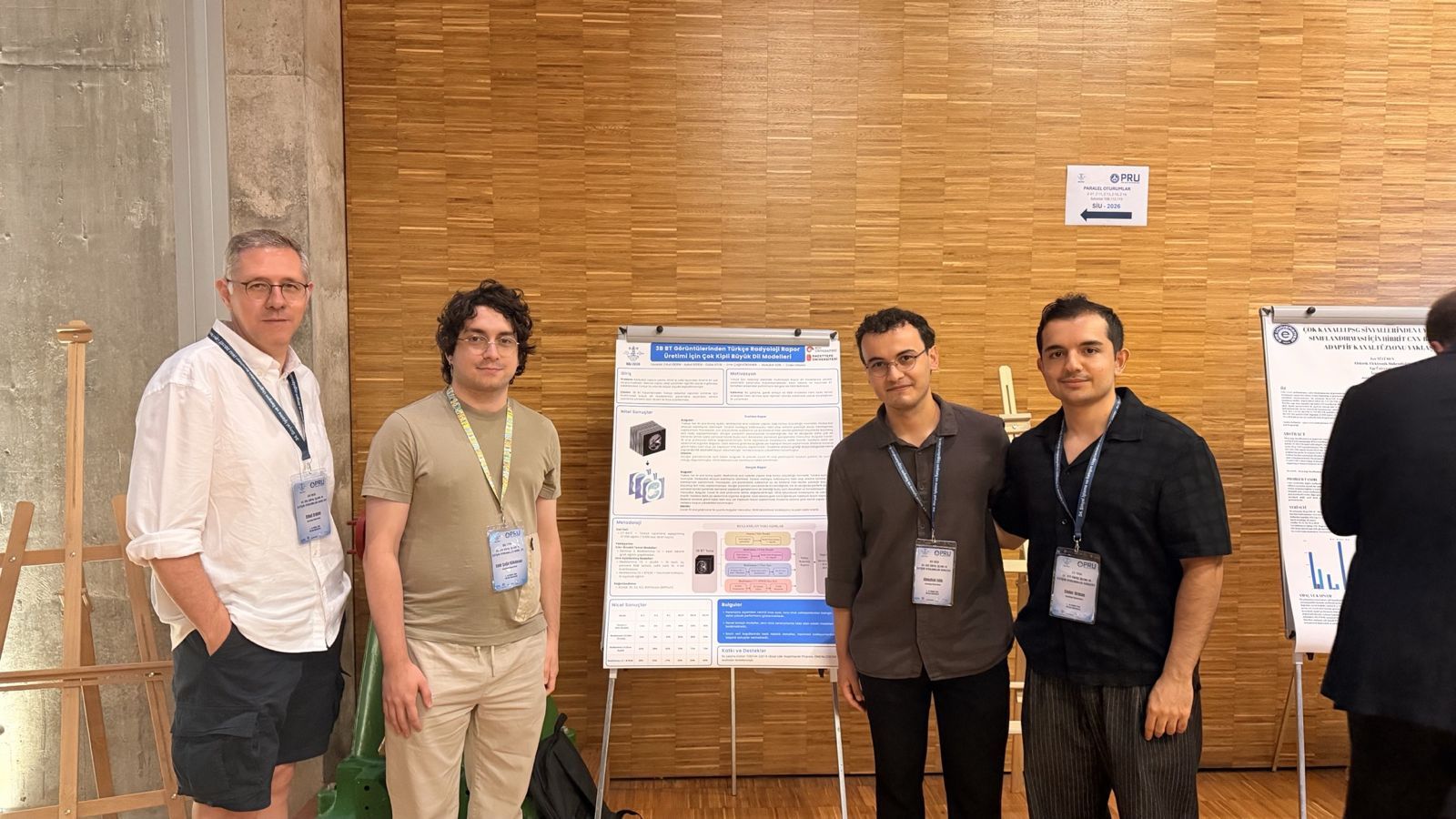
Poster presentation and discussion at SİU 2026.
The paper “Multimodal Large Language Models for Turkish
Radiology Report Generation from 3D CT Images” was accepted
and presented at SİU 2026, where the team discussed the study
with members of the research community and received valuable
feedback.
The study compares general-purpose and medically specialized
multimodal large language models for generating Turkish
radiology reports directly from three-dimensional CT volumes.
It evaluates slice-based and volumetric representations under
zero-shot and parameter-efficient fine-tuning settings. The
results show that fine-tuning is particularly important for a
low-resource clinical language such as Turkish and that, under
the evaluated settings, slice-based representations outperform
the volumetric approach.
The work was carried out by Artificial Intelligence
Engineering students Emir Çağıl Kökdener, Ender Orman, Gülse
Atun, and Abdullah Edik as part of their capstone project,
under the supervision of Erkut Erdem and Aykut Erdem (Koç
University).
Department website renewal
The website is being reorganized with a restrained academic
design and expanded information on the department, education,
people, research, students, and prospective students.
Students present medical AI research at the CVPR 2026
Med-Reasoner Workshop
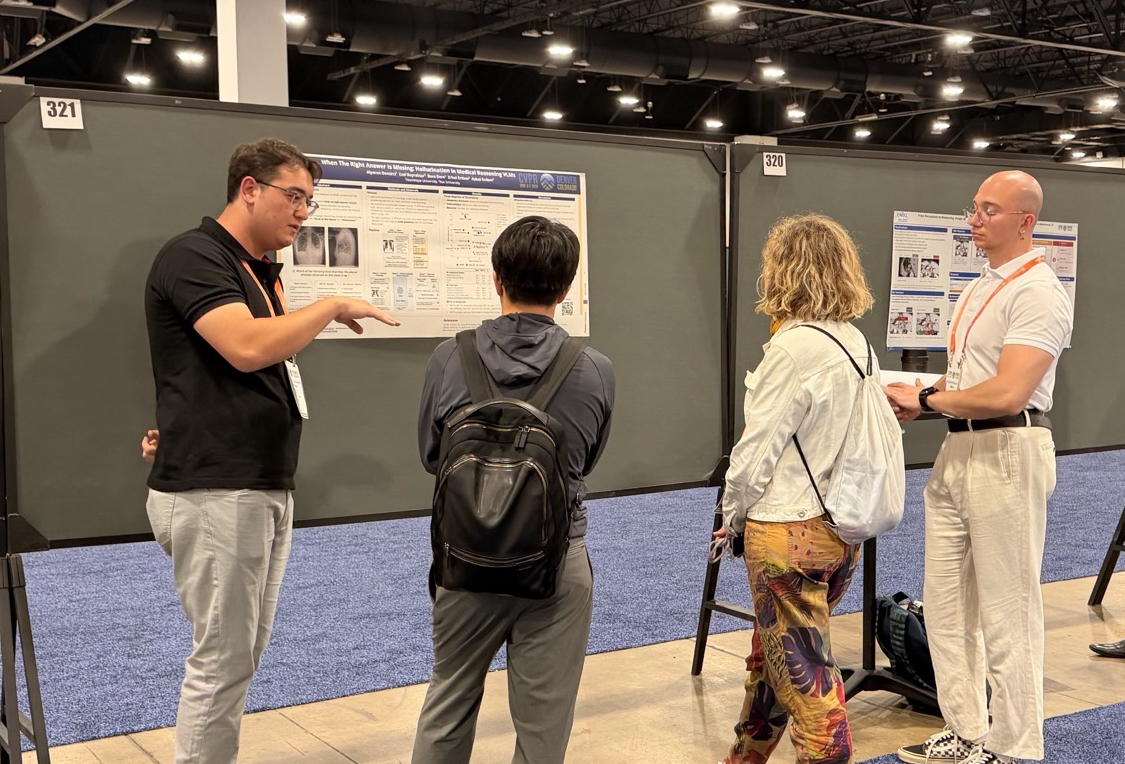
Poster presentation at the CVPR 2026 Med-Reasoner Workshop
in Denver, Colorado.
Alperen Demirci and Bora Dere, students in Hacettepe
University’s Artificial Intelligence Engineering undergraduate
program, together with Computer Engineering student Ezel
Bayraktar, presented their joint research at the Medical
Reasoning with Vision-Language Foundation Models
(Med-Reasoner) Workshop, held in conjunction with CVPR 2026 in
Denver, Colorado, USA.
The study was carried out under the supervision of Erkut Erdem
and Aykut Erdem and appears in the
CVPR 2026 Workshop Proceedings.
New academic structure
The Department of Artificial Intelligence and Data Engineering
operates within the Faculty of Computer and Information
Sciences alongside the Department of Computer Engineering.
Undergraduate curriculum development
The revised curriculum emphasizes strong foundations,
coordinated laboratory courses, data engineering, ML systems,
research practice, and flexible technical electives.
Hacettepe and ASELSAN advance joint AI research through
ASELABS
Building on the 2025 agreement to establish the
ASELSAN–Artificial Intelligence Laboratory under the ASELABS
Program, Hacettepe University and ASELSAN signed contracts for
three joint projects to be conducted within the laboratory.
The collaboration brings together academic expertise and
industrial research capabilities to support applied research
and technology development in artificial intelligence.